

How Natural Language Is Changing Software Development

I’ve spent over twenty years working across three continents — in commercial real estate, marketing, finance, blockchain, payments, M&A, and scaling businesses. One thing I’ve learned is that technology doesn’t just change industries; it reshapes who gets to participate in them.
I’ve seen startups with brilliant ideas fail because they couldn’t find the right developer. I’ve seen established companies stall because their tech team was overextended. And I’ve seen investors pass on opportunities simply because the founders didn’t have a specific technical background.
But today, we’re at the start of something transformative — something I believe is as big as the internet itself was in the ’90s. It’s called vibe coding, and it has the power to change the way we build, scale, and innovate.
What Is Vibe Coding?
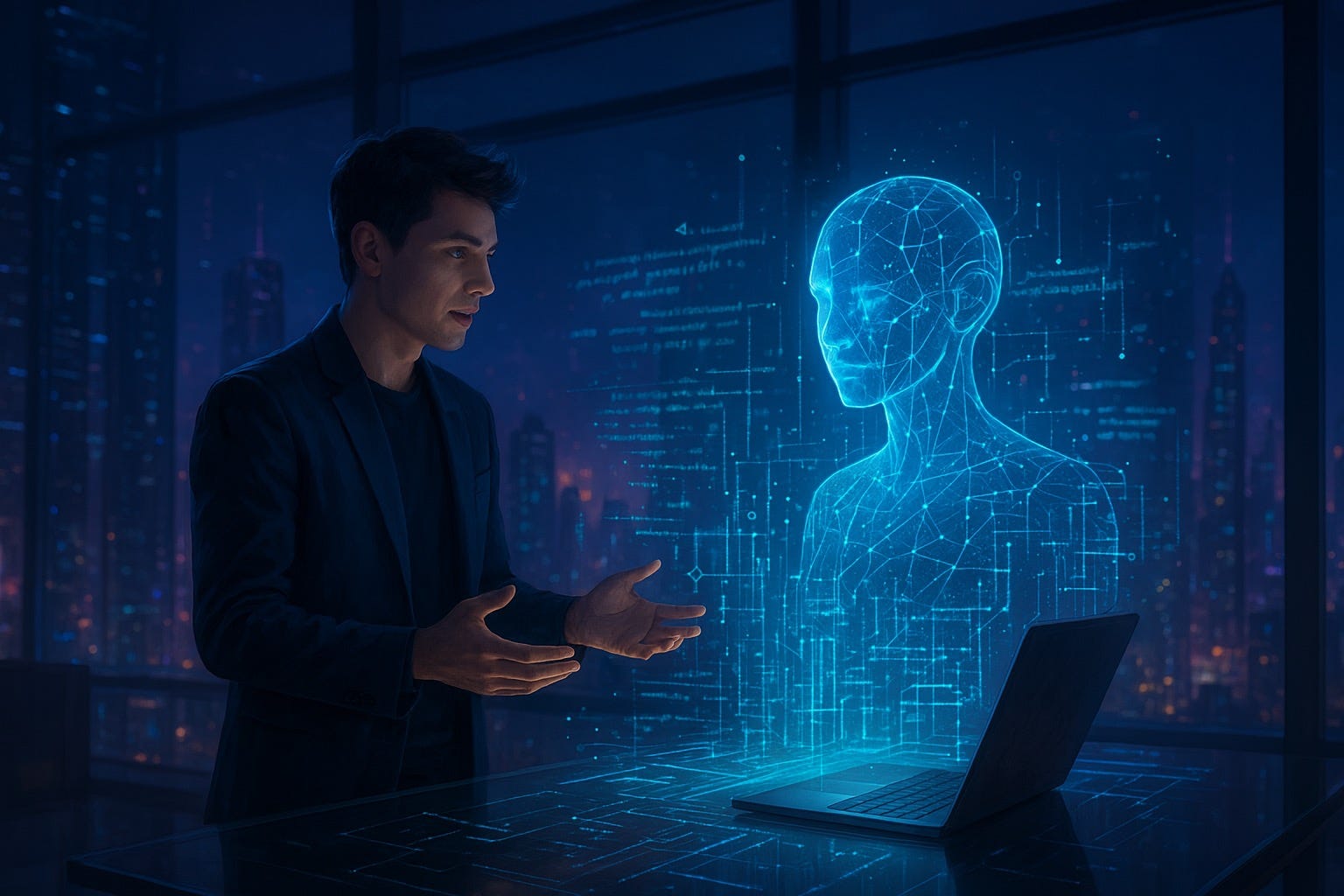
At its core, vibe coding means building software using natural language instead of traditional programming syntax.
If you’ve ever used AI to draft an email or to create an image, you already understand the principle: you describe what you want, and AI generates the result.
Vibe coding applies this same idea to software development. Instead of spending years learning Python, JavaScript, or C++, you can say something like:
“Create a web form that collects a user’s name and email, stores it in a database, and sends a welcome email automatically.”
And within seconds, you’ll have working code.
This isn’t science fiction — it’s happening right now with tools like GitHub Copilot, Replit’s AI, and Cursor. And it’s only the beginning.
Why This Matters
For decades, software development has had a high barrier to entry. You needed specialized skills, years of practice, and the patience to debug code line by line. That meant a huge number of creative, ambitious people were locked out of building their own solutions.
Vibe coding breaks down that barrier.
Entrepreneurs who don’t know how to code can now prototype their ideas themselves.
Small businesses can automate processes without hiring expensive developers.
Investors can test product concepts faster before committing capital.
Students can learn by doing instead of memorizing syntax.
In other words, vibe coding democratizes innovation.
When I co-founded AI Quantum Technologies in 2025, our mission was to explore how artificial intelligence and quantum computing could work together to solve problems that were previously out of reach — from advanced cybersecurity models to complex financial simulations.
Traditionally, experimenting with quantum algorithms or building AI–quantum hybrid models required highly specialized researchers and months of development time. But with vibe coding tools, even our non-technical research team could participate directly in early experimentation.
For example, one of our team members described in plain English:
“Simulate a quantum optimization problem for supply chain logistics and visualize the efficiency gains compared to classical algorithms.”
Within minutes, an AI-generated prototype was running simulations, producing visual outputs that our technical team could then refine, test, and secure for real-world application.
This doesn’t eliminate the need for world-class researchers — far from it. What it does is accelerate the innovation cycle. Instead of spending months setting up the basics before we could even begin testing, we could jump straight into iteration and exploration.
It’s the difference between sketching with a pencil and having a 3D model instantly rendered. The fundamentals of discovery remain the same, but the speed, accessibility, and scale are transformed.
What excites me most is not just what vibe coding means for startups in Silicon Valley or London, but what it means for entrepreneurs everywhere.
Think of a researcher in Eastern Europe who wants to run quantum-inspired simulations for new drug discoveries but doesn’t have access to a specialized lab. Or a climate scientist in Asia who needs to model complex weather patterns but lacks the resources to hire a team of quantum engineers.
With vibe coding, they don’t need a PhD in quantum physics or millions in infrastructure. They only need an idea — and the ability to describe it in natural language.
Just as quantum computing is unlocking new possibilities in science and AI is accelerating problem-solving, vibe coding is making these breakthroughs accessible to more people. And when you democratize access to advanced technologies, you democratize the solutions to some of humanity’s toughest challenges.
Will Developers Become Obsolete?
This is the question I get asked most often: “If AI can code, does that mean developers are out of a job?”
My answer is simple: no. Developers are not going away. But their role is changing.
Less time on boilerplate code (the repetitive parts AI can handle).
More time on architecture, security, and scaling.
Greater focus on strategy and product design.
If anything, vibe coding will make good developers even more valuable — because instead of spending time translating ideas into syntax, they’ll be focusing on building robust, scalable, and innovative systems.
It’s similar to how calculators didn’t make mathematicians obsolete — they made them more powerful.
The Future I See
I believe vibe coding will do for software what Canva did for design and WordPress did for websites. It won’t eliminate professionals — but it will open the doors for millions of people to participate.
In the next three to five years, I predict:
Founders without technical backgrounds will build MVPs themselves.
Investors will expect faster iteration cycles, because idea-to-prototype will take days, not months.
Education will shift, with students learning to problem-solve with natural language instead of memorizing syntax.
Entire industries will accelerate, because the bottleneck of “finding developers” will shrink dramatically.
Quantum-AI problem solving will become mainstream. Within the next decade, industries like finance, energy, and medicine will use AI–quantum hybrid systems to model risk, optimize logistics, and simulate molecules. What once took supercomputers weeks will take minutes.
Complex science will become accessible to non-scientists. A high school student in India or Brazil could one day “vibe code” a quantum chemistry simulation to test how a new material reacts under stress — something that today would require world-class labs and teams of specialists.
A new generation of cross-disciplinary entrepreneurs will emerge. We’ll see founders without traditional tech or physics backgrounds launch startups in fields like climate modeling, biotech, or advanced finance — because vibe coding will let them turn ideas into prototypes without waiting for gatekeepers.
And for those of us who are already building global businesses, this is an opportunity to move even faster.
My Personal Takeaway
I’ve built businesses, advised startups, and worked with investors across multiple industries. If there’s one lesson I’ve learned, it’s this: technology rewards those who adapt early.
Vibe coding isn’t a gimmick. It’s not a passing trend. It’s the natural evolution of programming.
And just as the internet created a new class of entrepreneurs, vibe coding will create a new class of builders — people who never considered themselves “technical” but who will now shape the digital future.
For me, that’s not just exciting. It’s liberating.
In the end, vibe coding isn’t just about writing code. It’s about expanding access. It’s about removing excuses. It’s about giving more people the chance to turn ideas into reality.
And that’s what Arlind’s Blueprint is all about — sharing the tools, the insights, and the mindset that will help you not just watch the future unfold, but take part in building it.
We’re at the start of a new era. The question is: will you be one of the builders?